
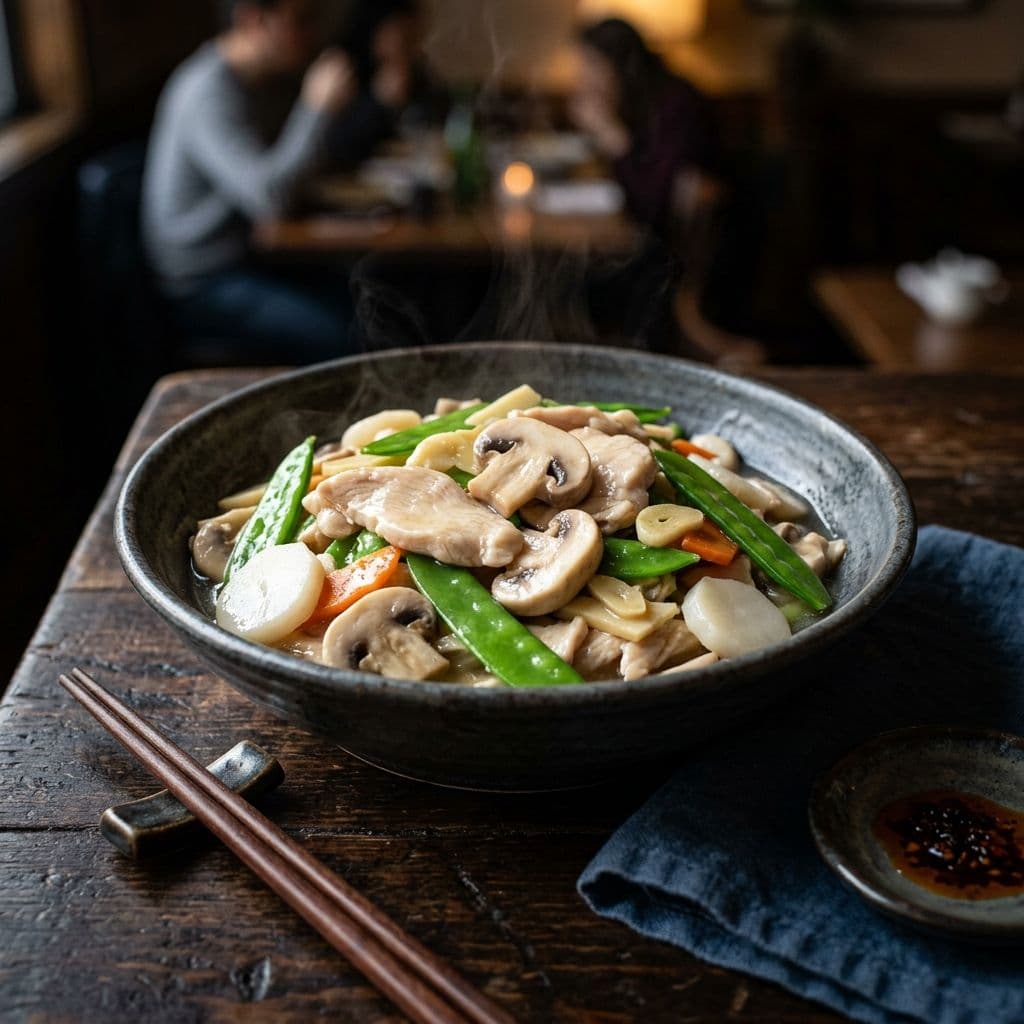
Moo goo gai pan (蘑菇鸡片) is sliced chicken stir-fried with mushrooms and vegetables in a light white sauce. Its Cantonese roots and how to order it at China Jade.
Moo goo gai pan is a Cantonese stir-fry of thinly sliced chicken breast and mushrooms with crisp vegetables in a light, ginger-scented white sauce. The name is Cantonese: móh gū (蘑菇) means mushrooms and gāi pín(鸡片) means sliced chicken. There is no chili, no heavy brown sauce, and no batter—which is exactly why it has stayed on Chinese-American menus for a century.
What the Name Means
“Moo goo gai pan” is an English spelling of the Cantonese pronunciation of 蘑菇鸡片—in Mandarin, mógū jīpiàn, literally “mushroom chicken slices.” The dish reached America with Cantonese immigrants, who built the first Chinese restaurants in the United States, and the Cantonese name stuck even as the dish spread to menus run by cooks from every region of China.
What's in It
- Chicken breast: sliced thin and velveted— coated in cornstarch and briefly blanched—so it cooks up silky instead of dry
- Mushrooms: the dish's namesake, typically button mushrooms
- Crisp vegetables: snow peas, water chestnuts, bamboo shoots, and carrots
- White sauce: chicken broth, ginger, garlic, and a touch of wine, thickened lightly with cornstarch
Velveting is the technique that separates a good moo goo gai pan from a rubbery one. It's the same treatment Cantonese kitchens give chicken and shrimp in most light stir-fries, and it's why the chicken in a restaurant version has a texture home cooking rarely matches.
Why the Sauce Is White
Most Chinese-American stir-fries ride on soy-based brown sauce. Moo goo gai pan deliberately skips it. The broth-based white sauce carries ginger and garlic without coloring or covering the ingredients—a classic Cantonese instinct, where the cooking is judged by how clearly you can taste the main ingredient. It's the opposite philosophy from the bold, layered heat of Szechuan cooking; the two traditions are compared dish by dish in our guide to Szechuan vs. Cantonese cuisine.
Is Moo Goo Gai Pan Healthy?
By Chinese-restaurant standards, yes. Lean white meat, a plate full of vegetables, no batter, no deep-frying, and a sauce that's mostly broth make it one of the lightest entrées on the menu. It is still a stir-fry cooked in oil, so it isn't a steamed dish—but if you want a full-flavored plate that won't weigh you down, this is the standard recommendation.
Who Should Order It
Moo goo gai pan is the dish for anyone at the table who doesn't want heat: kids, spice-averse guests, or anyone balancing out an order full of málà. If you're gauging what you can handle first, start with our Szechuan heat guide—moo goo gai pan sits at the mildest end of the scale.
Moo Goo Gai Pan at China Jade
We serve moo goo gai pan as a dinner entrée ($15.50) and as lunch special L3 ($10.95), which comes with fried rice, an egg roll, and soup, Monday through Friday, 11 AM–3 PM. Find it in the Poultry section of the full menu or on the lunch specials menu.
Visit China Jade
Order moo goo gai pan for dine-in, takeout, or delivery. Call (301) 963-1570 or order online. 16805 Crabbs Branch Way, Derwood MD, open daily 11 AM–9 PM.
Order Now →